
Emergency Support
+91 7774 223344Gynecology
Uterine Fibroids: Symptoms, Diagnosis and Treatment Options
Medical Disclaimer: This article is AI-assisted and intended for general informational purposes only. It does not replace professional medical advice, diagnosis, or treatment. Please consult a qualified healthcare specialist for advice specific to your condition. Read full disclaimer

Uterine fibroids are so common that by the time a woman reaches 50, up to 80% will have had them at some point. Yet few conditions in women's health are more misunderstood — or more often left unaddressed longer than necessary. This guide explains what fibroids are, why they cause the symptoms they do, how they are diagnosed, and when — and what kind of — treatment is genuinely needed.
What Are Uterine Fibroids?
Fibroids (also called leiomyomas or myomas) are non-cancerous growths of the smooth muscle of the uterus. They are not a form of cancer and do not become cancerous — the risk of malignant transformation (sarcoma) is exceedingly rare and estimated at less than 1 in 1,000. They vary enormously in size — from a seed to a melon — and in number, location, and the symptoms they cause.
Types of Fibroids by Location
- Submucosal — grow inside the uterine cavity, bulging inward. Even small ones cause heavy bleeding and are most likely to affect fertility.
- Intramural — within the wall of the uterus, the most common type. Larger ones distort the cavity and can cause heavy periods, pressure, and bulk symptoms.
- Subserosal — grow outward from the outer surface of the uterus. They can become very large before causing symptoms, usually pressure on adjacent organs.
- Pedunculated — attached to the uterus by a stalk; can be subserosal or submucosal.
Symptoms of Uterine Fibroids
Many fibroids cause no symptoms at all and are discovered incidentally on an ultrasound done for another reason. When they do cause symptoms, the most common are:
- Heavy or prolonged menstrual bleeding — the most common complaint. Soaking through pads or tampons every hour, passing clots, periods lasting more than 7 days, or anaemia from blood loss are all signs worth investigating.
- Pelvic pain or pressure — a sense of heaviness, fullness, or pressure in the lower abdomen. Larger fibroids may cause a visible abdominal bulge.
- Frequent urination or difficulty emptying the bladder — when fibroids press against the bladder.
- Constipation and backache — from pressure on the bowel and nerves.
- Pain during menstruation (dysmenorrhoea) or during intercourse.
- Recurrent miscarriage or difficulty conceiving — submucosal fibroids in particular interfere with implantation and carrying a pregnancy.
"A heavy period is not something women should simply endure. Heavy bleeding that is fibroid-related is one of the most treatable causes of anaemia in women, and the treatment options have never been better."
How Fibroids Are Diagnosed
Diagnosis is usually straightforward:
- Pelvic ultrasound — the first-line investigation. Transabdominal and transvaginal ultrasound together provide an accurate picture of fibroid size, number, and location.
- MRI — used to map multiple fibroids precisely before surgery, or when ultrasound is inconclusive.
- Hysteroscopy — a thin camera passed into the uterine cavity allows direct visualisation of submucosal fibroids and simultaneous minor treatment.
- Blood tests — to check for anaemia (haemoglobin, haematocrit) and rule out other causes of abnormal bleeding (thyroid, clotting disorders).
Treatment Options: Not Every Fibroid Needs Surgery
Watchful Waiting
Fibroids that are small and causing no significant symptoms can simply be monitored with an annual ultrasound. After menopause, without oestrogen stimulation, they typically shrink.
Medical Management
- Hormonal IUD (levonorgestrel-releasing): Does not treat the fibroid but significantly reduces heavy bleeding for women who do not want surgery.
- GnRH agonists: Temporary injections that put the body into a menopausal state, shrinking fibroids. Used short-term before surgery to reduce size and blood loss, or to bring on menopause in women approaching it.
- Non-hormonal medication: Tranexamic acid reduces blood loss during periods; NSAIDs reduce pain and some blood loss.
Minimally Invasive Surgical Options
- Hysteroscopic myomectomy — removal of submucosal fibroids through a hysteroscope (no incision). Day procedure, rapid recovery, excellent results for heavy bleeding and fertility.
- Laparoscopic myomectomy — removal of fibroids through keyhole surgery. Preserves the uterus, suitable for women wishing to conceive. Our laparoscopic team performs this routinely at Sankalp Hospital.
- Uterine fibroid embolisation (UFE) — a radiological procedure that cuts off the blood supply to the fibroid. Preserves the uterus; not suitable for women who want to conceive.
Hysterectomy
Surgical removal of the uterus definitively treats fibroids and is the most common major gynaecological surgery in India. It is appropriate for women with severe symptoms who have completed their families and where other treatments are not suitable. It can be performed laparoscopically (keyhole) with a faster recovery than open surgery.
How Sankalp Hospital Can Help
At Sankalp Hospital, Ambikapur, our gynaecology and laparoscopic surgery team diagnoses and treats uterine fibroids at every stage — from initial consultation and ultrasound, to hysteroscopic and laparoscopic surgery. Our advanced laparoscopy equipment allows us to perform minimally invasive fibroid surgery with shorter hospital stays and faster recovery. Book a consultation if you are experiencing heavy periods, pelvic pressure, or difficulty conceiving.
Watch: Related Videos
Related health videos from the Sankalp Hospital YouTube channel.
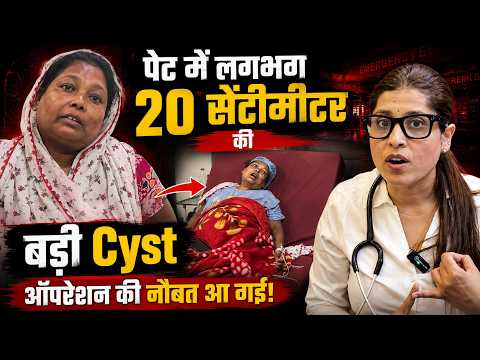 पेट में 20cm की Cyst बेटी की शादी की चिंता में जी रही थी मां | Dr Ankita Bansal Goyal
 Vaginal Swelling Causes | योनि में सूजन का कारण क्या है? | Dr. Ankita Bansal Goyal
Frequently Asked Questions
Related Articles